 English
 中文简体
中文简体 Français
 Español
 عربى
عربى
Inside a China Entrance Door Factory: Production Process and Craftsmanship
Jun 26, 2026
Entrance doors are not just building parts. They sit at the point where outside meets inside. In China entrance door factories, production is not a single straight action. It feels more like a long chain of small steps, each one depending on the previous one.
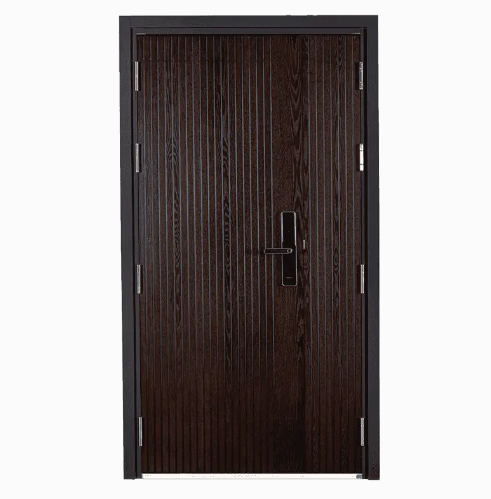
What stands out is not only machinery. It is the mix of structured production and quiet manual adjustment. The door you see at the end has already passed through many hands and many small decisions.
What does the factory do before anything is assembled?
Before a door becomes a door, there is a stage that looks simple but actually matters a lot.
Materials arrive first. They are not mixed together. They are separated and placed in different zones. Metal sheets stay in one area. Inner filling materials stay in another. Surface-related parts are stored separately.
Nothing is rushed here. Workers usually check the condition of materials before they move forward. Not in a complicated way. Just basic checking. Is the surface clean. Is the material stable. Does it look ready for forming.
This step feels quiet, but it prevents problems later in production.
How does a flat sheet turn into a door frame?
The frame is the part that decides whether the door feels solid or weak.
Metal sheets are cut first. Then they are bent or shaped into long frame sections. These sections are brought together and aligned.
Welding connects everything. You can often see sparks, but what matters more is alignment. If the frame is even slightly off, the door might not sit properly later.
After welding, the frame is not immediately moved forward. It is checked again. Sometimes workers look at it from different angles, just to confirm it is straight enough.
Small corrections happen here too. A slight adjustment by hand is still common in many factories.
What is actually inside the door?
Most people only see the outside of a door. Inside, there is another layer that stays hidden.
This inner part is usually a filling structure placed between two panels.
It is not decorative. It is functional.
It helps with:
- Keeping the door from feeling hollow
- Supporting overall stability
- Helping reduce outside impact
- Balancing weight so the door does not feel too heavy or too light
Different projects may use slightly different filling materials. Some focus more on firmness. Some focus on balanced structure.
Workers place this inner part carefully before sealing the outer panels.
Once closed, it becomes part of the door's internal system. You do not see it again, but it keeps working in the background.
How do outer panels change the final look?
After the inside is set, attention moves to the outside surface.
Outer panels are attached on both sides of the frame. This is where the door starts to look complete.
But appearance is not the only concern.
Before final assembly, the surface goes through treatment steps. Some parts are pressed. Some are smoothed. Some are coated.
Coating is important because doors face real environments. Sunlight, moisture, temperature changes. The surface has to stay stable through all of that.
This stage is controlled carefully. If the surface is uneven, it will be noticeable later. So workers usually take time here, even if it slows production slightly.
How do factories make sure the door feels stable?
A door can look fine but still feel wrong when used. That is why testing comes after assembly.
At this stage, the door is treated as one complete object.
It is moved, opened, closed, and checked for balance.
Workers usually pay attention to simple things:
- Does it open smoothly
- Does it close without force
- Does the frame feel steady when handled
- Do edges align properly when shut
If something feels off, it is not ignored. Small adjustments are still made at this point.
Many of these corrections come from experience rather than tools. You can measure parts, but you also need to "feel" how the door behaves.
Where does craftsmanship still exist in factory production?
Even in a modern factory, there are moments that are not fully machine-driven.
Craftsmanship shows up in small adjustments.
It might be a worker slightly correcting a frame position. Or adjusting a weld point. Or checking a door again because something "doesn't feel right."
These are not big actions. But they affect the final result.
Two doors can go through the same process and still feel slightly different when you use them. That difference often comes from these small human decisions.
Craftsmanship here is not decoration. It is control and correction during production.
What happens before the door leaves the factory?
Before packing, every door goes through a final round of checking.
This is not a quick look. It is a full confirmation stage.
The door is reviewed as a complete unit:
- Movement check
- Surface check
- Alignment check
- Structure check
After that, protective layers are added. The goal is simple: avoid damage during transport.
Only after this stage is the door considered ready to leave the factory.
How do factories deal with different environments?
Not all doors are used in the same place. Some face humidity. Some face dry air. Some are used in busy buildings, others in quiet residential spaces.
Because of this, factories do not treat every order the same way.
Adjustments may happen in:
- Inner structure strength
- Surface treatment type
- Frame reinforcement layout
- Assembly balance
These changes are not always visible. From the outside, doors may look similar. But inside, small differences exist to match usage conditions.
What does the production flow feel like inside the factory?
Production does not feel like separate tasks. It feels continuous.
Materials move in. Frames are formed. Inner parts are placed. Panels are fixed. Surfaces are treated. Then final checks happen.
One stage flows into the next without stopping for long.
If one step is not stable, everything after it feels harder to control. That is why each stage gets attention, not just the final one.
How does design connect with manufacturing?
Design is not only about how the door looks. It also affects how it is made.
A simple design is easier to assemble. A complex surface pattern may require more processing steps. Shape also affects how materials are cut and aligned.
So factories think about design and production together.
They ask simple questions:
- Will this shape be stable in real use
- Can this surface be processed evenly
- Does this structure make assembly smooth
Design decisions and factory reality always meet somewhere in the middle.
What defines modern craftsmanship in entrance door factories?
It is not about handmade decoration. It is about small corrections during a structured process.
Craftsmanship appears in:
- Alignment adjustments
- Welding corrections
- Surface finishing decisions
- Final movement tuning
These actions are not always visible in the final product. But they shape how the door behaves in daily use.
In a China entrance door factory , production and craftsmanship are not separate ideas. They run together in the same flow, quietly shaping every finished door.
Share:
Related Products

 No. 1266, Huajie West Avenue, Yongkang City, Zhejiang Province, China
 [email protected]
 +86-13626793298
 [email protected]
Copyright © Yongkang Chenma Industry and Trade Co., Ltd. All rights reserved.

Sale Entrance Solid Wood Front Doors Manufacturer