 English
 中文简体
中文简体 Français
 Español
 عربى
عربى
Structural Stability Advantages of Modern Spliced Wood Doors
Jan 16, 2026
Door Stability and Material Behavior
In door manufacturing and architectural applications, stability and deformation control are critical performance indicators that directly affect durability, appearance, and daily usability. Traditional solid board doors made from a single wide panel have long been valued for their natural look, yet they also present inherent structural risks. Wood is a hygroscopic material that expands and contracts with changes in humidity and temperature, and when this movement is concentrated within one large piece, deformation becomes difficult to control. In contrast, a Spliced Door uses multiple smaller wood segments joined together in a controlled structure, offering distinct advantages in maintaining shape and alignment over time.
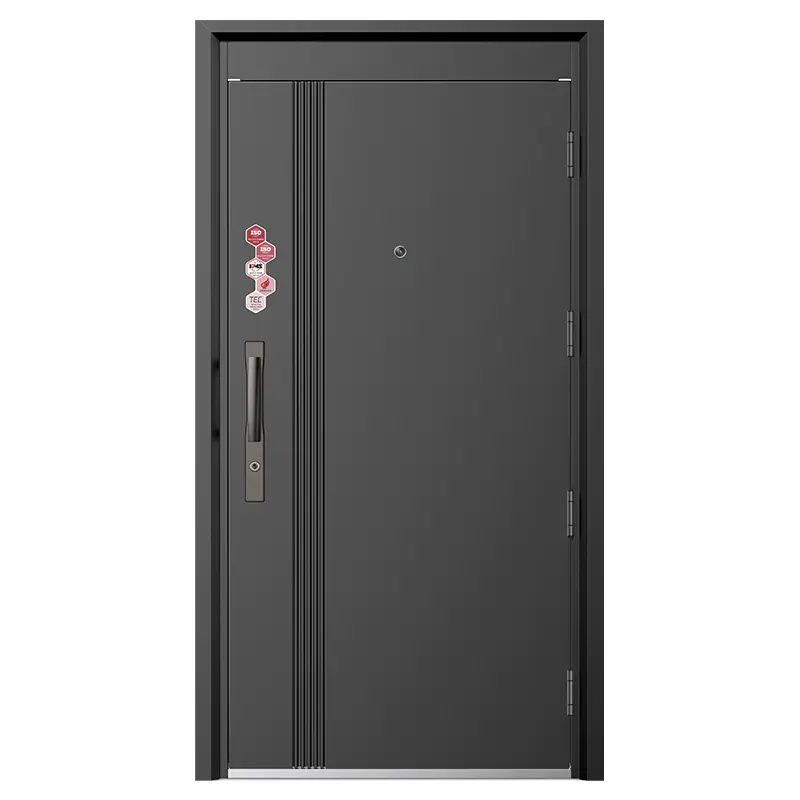
Understanding the Nature of Wood Movement
To appreciate why spliced construction improves stability, it is important to understand how wood behaves. Wood fibers expand primarily across the grain rather than along it, and the wider the board, the more pronounced this movement becomes. A single-piece board door concentrates all internal stress within one panel, increasing the likelihood of warping, cupping, or twisting as environmental conditions change. By dividing the door leaf into multiple narrower sections and bonding them together, internal stresses are redistributed. This structural segmentation reduces the magnitude of movement in any one direction, allowing the door to adapt more evenly to environmental fluctuations.
Stress Distribution Through Engineered Splicing
One of the significant stability advantages of spliced construction lies in stress balancing. In a properly designed spliced structure, wood grains are often oriented in alternating or complementary directions. This approach counteracts natural tendencies for movement, as opposing grain directions help neutralize internal stress. Rather than allowing tension to accumulate across a single wide surface, the spliced configuration disperses it across multiple joints. As a result, the door maintains its flatness and alignment more effectively than a solid board alternative, particularly in large-format or tall door designs.
Reduced Risk of Warping and Twisting
Warping and twisting are common deformation issues associated with single-panel doors, especially when installed in environments with fluctuating humidity, such as residential interiors, commercial buildings, or transitional spaces. Because spliced doors consist of smaller components bonded under controlled pressure and moisture conditions, each segment has already undergone a degree of stabilization during manufacturing. This pre-conditioning significantly reduces the likelihood of post-installation deformation. Over time, the door leaf remains straighter, reducing the need for corrective maintenance or hardware adjustments.
Improved Moisture Adaptability in Variable Environments
Moisture is one of the influential factors affecting wood stability. Solid board doors are particularly vulnerable when exposed to uneven moisture absorption, which can cause one side of the panel to expand faster than the other. Spliced construction mitigates this issue by limiting the surface area of each wood segment, allowing moisture-related movement to occur more uniformly. When combined with modern adhesives and surface finishes, this design provides enhanced resistance to swelling and shrinkage, making spliced doors more adaptable to diverse climate conditions.
Enhanced Dimensional Stability for Large Door Formats
As architectural trends increasingly favor oversized doors and minimalist designs, dimensional stability becomes even more critical. Large solid board doors are particularly prone to sagging and deformation due to their weight and surface area. A Spliced Door structure offers good dimensional stability by distributing weight more evenly across the door leaf and internal framework. This balanced load reduces strain on hinges and frames, contributing to smoother operation and extended hardware lifespan.
Share:
Related Products

 No. 1266, Huajie West Avenue, Yongkang City, Zhejiang Province, China
 [email protected]
 +86-13626793298
 [email protected]
Copyright © Yongkang Chenma Industry and Trade Co., Ltd. All rights reserved.

Sale Entrance Solid Wood Front Doors Manufacturer